The Importance of the Cold Chain in Catering and Hospitality
In the food sector, preservation at controlled temperatures is fundamental to ensure freshness, quality, and, above all, biological safety of perishable products. A professional walk-in cold room is the heart of cold logistics in any restaurant, hotel, supermarket, or industrial kitchen, replacing multiple individual refrigerators with a single high-capacity and energy-efficient solution.
What is a Professional Walk-in Cold Room?
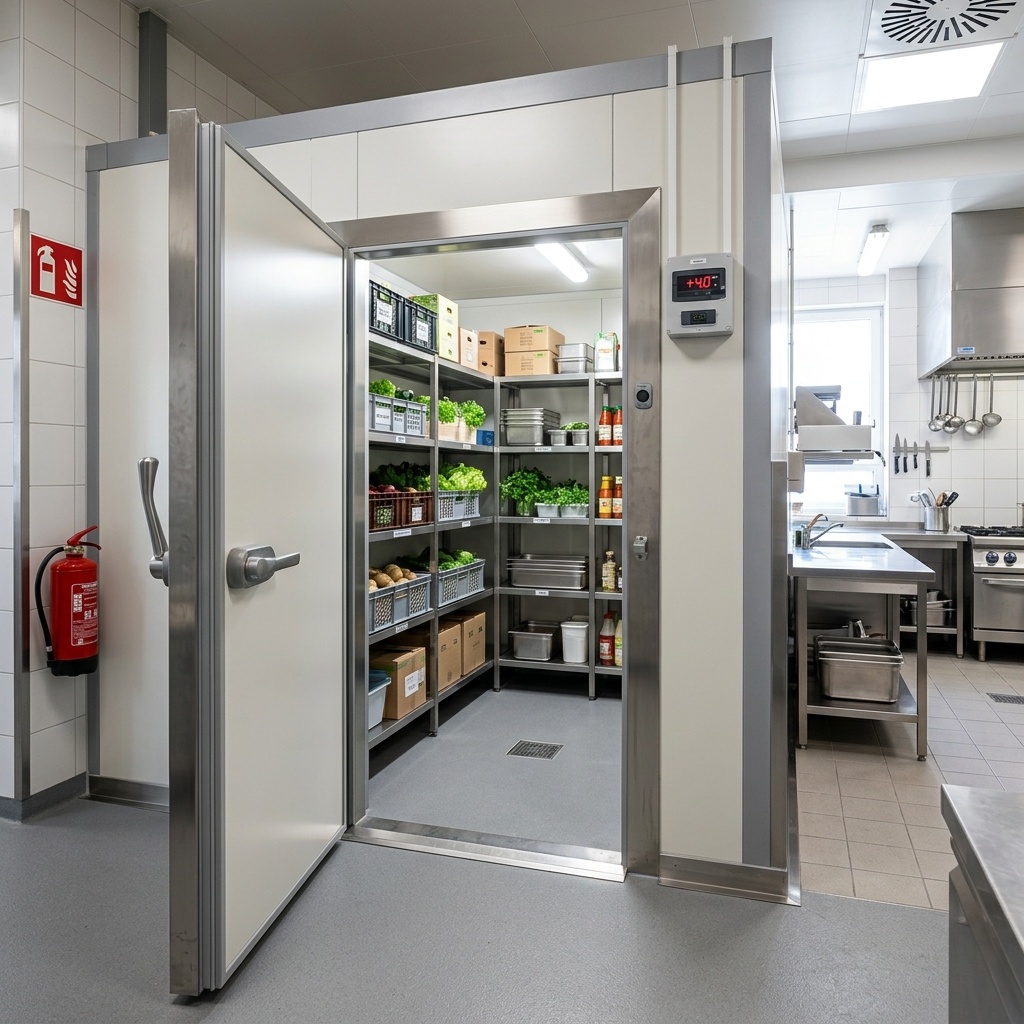
It is a thermally insulated space, built with modular polyurethane panels, designed to store food and beverages at controlled temperatures. Unlike domestic or small commercial refrigerators, a walk-in cold room allows staff to enter and organize large volumes of inventory, supported by adjustable shelving systems.
Positive or Negative Cold Room: What is the Difference?
Walk-in cold rooms are divided into two main types based on the required operating temperature:
- Positive Cold Rooms (Refrigeration): Operate above 0°C (usually between 0°C and 5°C). They are used to preserve fresh foods (fish, meat, fresh vegetables, dairy) without freezing them.
- Negative Cold Rooms (Freezer Storage): Operate below zero (typically between -18°C and -21°C). They are designed to store food that has already been frozen and maintain it in that state. For this reason, they are commonly called freezer storage rooms (freezing fresh products should be done in dedicated blast chillers).
Reference Temperatures by Product
- Fresh fish: 0°C to 2°C (low temperatures and controlled humidity).
- Fresh meat: 0°C to 3°C.
- Dairy and charcuterie: 2°C to 5°C.
- Vegetables and fruits: 6°C to 10°C (slightly higher temperatures to avoid freezing plant tissue).
- Frozen products: -18°C to -21°C.
Technical Tip: If your operation stores fish, meat, and fresh vegetables, it is advisable to have separate positive cold rooms. Each group requires different temperatures, and keeping fish and meat in the same room can lead to cross-odor contamination.
Types of Cooling Groups
Selecting the correct refrigeration engine is vital for kitchen efficiency and noise levels:
- Monoblock Groups (Straddle/Mochila): Compact units easy to install, mounted directly onto the cold room panel. The compressor, condenser, and evaporator are integrated. Advantages: Low initial cost and quick assembly. Disadvantages: Release noise and heat directly into the kitchen, requiring good room ventilation.
- Ceiling Groups: Similar to monoblocks but installed on the top panel of the cold room, freeing up side space. Disadvised in kitchens with low ceilings.
- Remote Groups (Split/Partidos): The evaporator is inside the cold room, and the compressor/condenser is installed outside the building (similar to air conditioning). Advantages: No heat or noise in the kitchen, higher thermal efficiency. Disadvantages: Higher equipment and copper piping installation costs.
- Centrifugal Groups: Monoblock or ceiling versions that use centrifugal fans, allowing heat to be ducted to the outside. Excellent technical compromise when a remote engine is not viable.
Cold Room With or Without Floor?
- Cold Room Without Floor (Floorless): Mounted directly onto the kitchen floor (the side panels rest on a PVC profile fixed to the ground). Advantages: No ramps or steps, facilitating direct access with carts or pallet jacks. More cost-effective. Disadvantages: Only recommended for positive refrigeration (above zero). Can have thermal loss if the kitchen floor is not well insulated or leveled.
- Cold Room With Floor (Insulated Floor): Features an insulated floor panel covered with non-slip material. Advantages: 100% airtight thermal insulation, mandatory for negative freezer rooms to prevent moisture penetration and floor icing. Disadvantages: Creates a small step requiring a ramp if you plan to roll carts in.
Panel Thickness and Insulation
Panel thickness directly impacts electricity consumption:
- 60 mm to 80 mm panels: Industry standard for positive cold rooms (refrigeration). They provide sufficient insulation for temperature ranges from 0°C to 10°C.
- 100 mm panels: Required standard for negative cold rooms (freezers). The extra thickness minimizes cold loss in environments where the temperature difference with the outside is extreme.
How to Calculate Dimensions and Volume
Do not confuse external and internal measurements:
- In 60 mm panels, the difference between external and internal walls is 120 mm (60 mm on each side). If the cold room measures 2000 mm externally, the internal space will be 1880 mm.
- In 100 mm panels, the difference is 200 mm.
- Volume (in m³) determines the required power of the cooling group. Calculate it by multiplying: `Internal Width x Internal Depth x Internal Height`.
Note on Ambient Temperature: If the cold room is installed in a hot environment (such as a poorly ventilated central kitchen or in high-temperature regions like the PALOP countries), a cooling group with thermal oversizing should be selected to compensate for frequent door openings.
Why Modular Shelving is Crucial
Interior organization with proper shelving guarantees:
- Food safety: Prevents food from touching the floor (a major HACCP violation).
- Air circulation: Cold air needs to flow freely. Shelves with perforated grids are essential.
- Simple hygiene: Polyethylene shelves with aluminum frames can be washed directly in a commercial dishwasher.
Main Mistakes to Avoid
- Placing a monoblock engine in a closed room: The engine overheats, power consumption spikes, and compressor life is shortened.
- Using 60 mm panels for negative cold rooms: Leads to ice formation at panel joints, loss of cooling power, and constant system failures.
- Blocking air circulation: Stacking boxes directly against the evaporator stops the air from cooling the room properly.
Quick Checklist for Choosing the Ideal Cold Room
- Have you defined whether the room is for positive refrigeration or negative freezing?
- Is the installation floor perfectly level?
- Do you need an insulated floor or can you install it floorless?
- Where will the condenser heat be exhausted (monoblock in the kitchen or remote outside)?
- What is the kitchen ceiling height (does it allow a ceiling group or require a side block)?
- Does the layout include aluminum/polyethylene shelving in compliance with HACCP?
- Is the panel thickness adapted to the operating temperature?
How Upgreat Can Help
The Upgreat technical team sizes the cold room according to your operation, designs the 2D shelving layout to optimize space, and selects the cooling groups best suited to the local climate.
For consulting and comparing professional equipment, Upgreat also provides an online catalogue with more than 2,000 references at upgreat-shop.com.